Audio Transcription: What It Is, Best Tools & How to Do It Online (2026 Guide)
The definitive guide to audio transcription: learn how speech-to-text works, compare leading AI and free tools, and convert any recording into punctuated text in seconds.
Audio transcription is one of the most transformative technologies of the modern digital workspace. Whether converting business meetings into official minutes, transcribing research interviews for a master's thesis, or reading long voice notes and podcasts, transforming spoken voice into editable text saves dozens of hours of repetitive work every week.
Yet many people still associate this task with putting on headphones, opening a blank Word document, and pausing every three seconds to type word by word. Others rely on crude dictation tools that output run-on text with zero punctuation and spelling errors.
In this definitive 2026 guide, you will learn what audio transcription actually is, review the different types of transcription, compare the top tools available, and learn how to convert voice recordings into Word (.docx), PDF, or TXT in under a minute.
What is audio transcription and how does it work?
Audio transcription is the process of converting spoken language from an audio or video recording into formatted, readable text.
Professional-grade transcription goes far beyond stringing words together. It requires:
- Phonetic Recognition: Distinguishing homophones and discerning vocabulary from context.
- Punctuation & Intonation: Detecting speech pauses, question intonations, and sentence boundaries to insert commas and periods accurately.
- Paragraph Segmentation: Organizing spoken thoughts into cohesive blocks for effortless readability.
- Speaker Diarization: Identifying and separating different speakers during panels, debates, and meetings.
From manual typing to Deep Neural Networks
Until recently, speech recognition software required users to spend hours "training" their voice profile with scripted prompts.
Today, modern Deep Learning architectures (such as OpenAI Whisper and neural speech models) have changed the landscape. Trained on hundreds of thousands of hours of multilingual speech, these models comprehend regional accents, ambient background noise, and specialized industry jargon with up to 99% accuracy.
The 3 Main Types of Audio Transcription
- Verbatim (Word-for-Word): Captures every single utterance, including false starts, repetitions, and filler words ("um", "ah"). Essential for legal depositions and courtroom proceedings.
- Clean Verbatim (Standard / Intelligent): Removes verbal tics, stuttering, and fillers while keeping 100% of the original meaning and phrasing. Ideal for business meetings, podcasts, and video captions.
- Summarized / Executive Briefing: Condenses long discussions into core themes, key decisions, and actionable checklists.
Step-by-Step: How to transcribe audio to text online
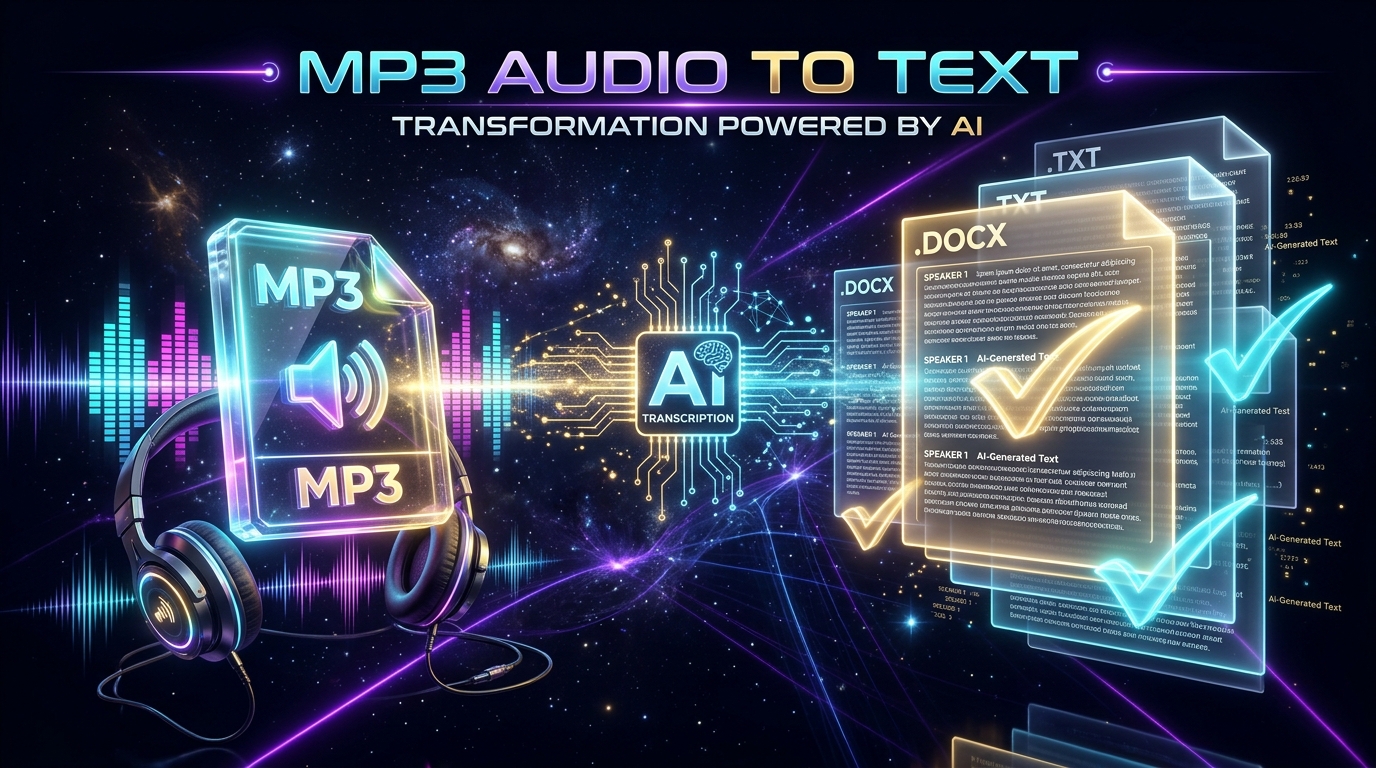
- Select your audio recording: We support all standard formats (MP3, WAV, M4A, AAC, OGG, OPUS) up to 2 GB.
- Upload to Peguei o Texto: Drop the audio file in the uploader.
- Export Document: In less than 60 seconds, download your punctuated text in Word (.DOCX), PDF, or plain text (.TXT).
Start transcribing your audio free on Peguei o Texto with 5 complimentary minutes!
Transcribe your first audio or video in seconds
Upload MP3, WAV, Zoom recordings or paste any YouTube link. Test our AI with 5 free minutes and experience studio-grade accuracy!
Start Free on Peguei o TextoRelated Articles
Continue reading other guides in this category